

Define the business service you need to recover
Recovery should begin with a specific business outcome: accepting customer orders, releasing a shipment or running payroll. For that outcome, map the application, identity provider, network services, databases, integrations and people required. A restored database is of limited use when its encryption key, service account or upstream system remains unavailable. Agree a minimum acceptable service and the temporary manual process that can support it.
Record recovery time and recovery point objectives as requirements to test, rather than promises. Measure elapsed time from the agreed incident starting point through investigation, rebuilding, reconciliation and business approval. A backup-console success message measures a different event. Keep the dependency map accessible through a trusted channel that does not depend on the affected environment.
Contain the incident while protecting useful evidence
Appoint an incident lead and establish a trusted communication route. Coordinate proportionate containment with responders who understand the systems and any safety constraints. Isolation can prevent further spread, but ad hoc deletion, reinstallation or powering down can remove evidence needed to understand the intrusion. Record the reason, operator and time for each material action.
Plan collection around volatile information, endpoint records, identity events, cloud audit trails and backup administration logs. The sequence depends on the threat and operational risk; evidence preservation must not become an excuse to leave harmful activity running. Preserve original exports, collection details and working copies separately. Treat an absence of alerts as a visibility question, not proof that an environment is clean.
Assess the identity and management layers
Restoring business workloads into a compromised management plane can recreate the incident. Review privileged identities, remote administration paths, federation settings, service principals, recovery accounts and backup administrators. Determine which credentials, sessions, certificates or secrets may require replacement, and how replacements will reach dependent applications safely.
Use the intrusion timeline to guide the scope. Encryption may occur well after initial access, so the last pre-encryption backup is not automatically trustworthy. Document what was examined, the time period supported by available telemetry and the remaining uncertainty. A negative scan cannot establish that every persistence mechanism has been excluded.
Restore into a controlled recovery environment
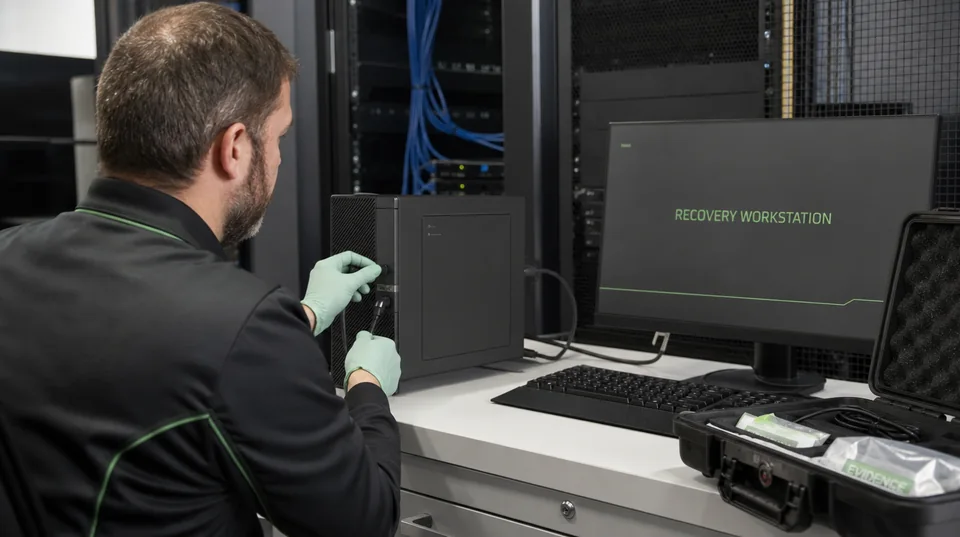
Establish an appropriately isolated recovery environment with known configuration, controlled administration and monitoring. Validate backup accessibility and integrity before committing the full restoration sequence. Examine recovery material for signs of compromise and rebuild components where the evidence and system design support that choice. Avoid importing unreviewed scheduled tasks, startup configuration or privileged credentials with the data.
Recovery testing should exercise business transactions, not just system startup. Check data consistency across applications, permissions, integrations, scheduled processing and monitoring. If orders were taken manually during the outage, define how duplicates, missing sequence numbers and conflicting updates will be reconciled. Give each exception an owner before reconnecting the service.
Make reconnection an explicit decision
Use a release record for each recovered service: relevant intrusion paths addressed, identity actions completed, restoration checks passed, monitoring active, business tests accepted and unresolved risks documented. Assign named technical and business approvers. Their decision should refer to evidence and defined scope, rather than a general statement that everything is safe.
Reintroduce services in stages when dependencies permit, with observation periods and a plan for renewed containment. Separate the recovery decision from the assessment of possible data theft. Successful restoration does not establish that confidential information was not accessed or removed. Legal, contractual and notification questions need their own documented assessment with the appropriate advisers.
Commission a rehearsal with measurable outputs
Ask for a scoped exercise that follows one important service from disruption to accepted recovery. Useful outputs include the dependency map, evidence and identity action lists, restore timings, a transaction reconciliation record and a prioritised improvement plan. Agree which steps are simulated and which are executed, so exercise results are not mistaken for a production recovery guarantee.
TRUST-IT can help connect intrusion investigation with recovery planning and validation. Bring the service owner, infrastructure team, security team and key provider into the same scoping discussion. The valuable question is whether the organisation can explain why a service is ready to resume, and produce the evidence behind that decision.
Further reading
Put the guidance to work
Technical investigation of ransomware, malicious activity, network intrusions and possible data theft, from entry point to recovery validation.
Ransomware & intrusion analysis