
Enterprise knowledge assistants & secure RAG
Make company knowledge easier to find and use, with access controls that follow the source information. We build AI assistants that retrieve relevant material, show supporting sources and help staff work across Greek and English content.
Discuss your requirements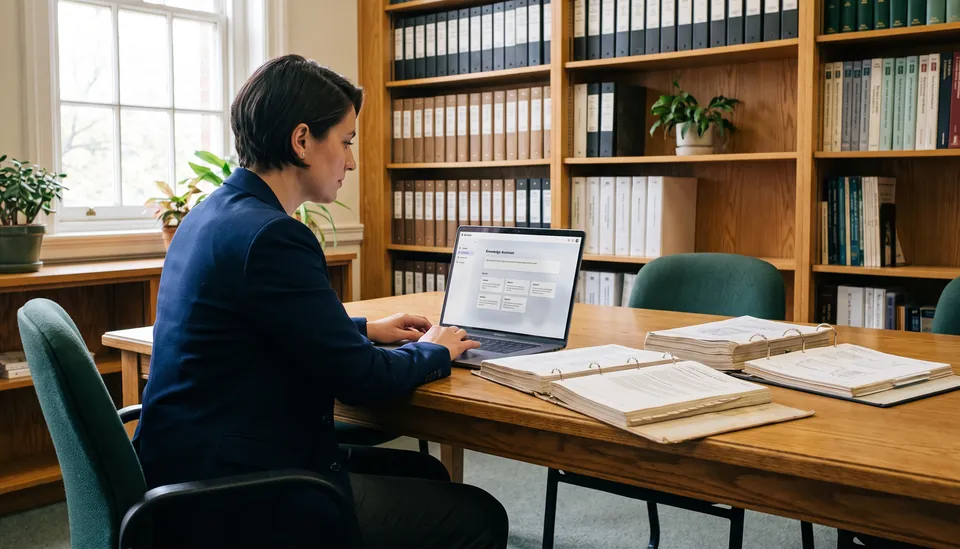
Choose the knowledge problem worth solving
Teams often lose time finding the right policy, comparing document versions or asking colleagues the same operational questions. We select a defined audience and a bounded collection of approved information before building an assistant. The discovery stage records the questions people actually ask, how they answer them today, the cost of a wrong response and which decisions require a qualified human.
Prepare sources and preserve their boundaries
A useful assistant depends on document quality, ownership and permissions. We inventory repositories, identify authoritative versions and define update and deletion workflows. The retrieval design preserves relevant document context and carries access restrictions through ingestion, indexing, retrieval and presentation. An employee should not gain access to restricted information simply because a search or generated answer passes through an AI system.
Ground answers in relevant evidence
Retrieval-augmented generation, or RAG, supplies selected source material to the model when a question is answered. We design retrieval, answer structure and citations around the business task. The system should distinguish an answer supported by approved sources from a request with insufficient information. Citations are checked for whether they actually support the answer; a plausible-looking reference is not enough.
Evaluate Greek, English and difficult questions
We build a test set from real questions, including ambiguous wording, abbreviations, outdated instructions, conflicting sources and questions the assistant should decline or escalate. Greek morphology, mixed-language documents and organisation-specific terminology are evaluated directly. Measures can include retrieval relevance, answer correctness, unsupported statements, permission failures, response time and the amount of human correction required.
Integrate the assistant into a maintainable workflow
The delivery can include an internal portal, service-desk integration or another approved work environment. We define identity, logging, feedback and content-owner responsibilities, alongside provider settings and data handling. A phased rollout lets a small team validate usefulness before wider access. Changes to models, retrieval or source collections pass through regression checks, with a documented fallback when the service cannot provide a reliable answer.

Find policies, technical knowledge and approved answers
Useful starting points include an internal policy assistant, a support knowledge search or a technical reference tool for a distributed team. We identify the questions that currently require repeated searching or expert interruption, then select the approved source collection. The assistant should help users locate the relevant material and understand its context, with a path to a responsible person when the source does not resolve the question.
Handle conflicting, obsolete and restricted documents
A document repository can contain several versions of the same policy or material intended for different entities. We define how source ownership, effective versions and access rules influence retrieval. Tests include questions whose answers changed and users who should not see a document. The content owner needs a practical way to update or withdraw sources and confirm that the assistant reflects the change.
Measure answer usefulness beyond fluent language
An answer can sound clear while relying on the wrong source. Evaluation should examine whether the retrieved material is relevant, whether the answer is supported and whether the user can follow the reference. We include unanswered and ambiguous questions as well as routine ones. A pilot review compares search effort, reviewer corrections and the remaining escalation burden with the previous knowledge workflow.
What you receive
- Knowledge-source inventory and access model
- Working assistant with source references and controlled retrieval
- Greek and English evaluation set and results
- Content update, deletion and ownership procedures
- Integration, monitoring and operational handover
- Approved-source and ownership map with version and access rules
- Knowledge-assistant evaluation covering citations, ambiguity and unanswered questions
Common questions
Is RAG the same as training a model on our documents?
No. RAG retrieves selected material for a request. Training changes model parameters. The appropriate approach depends on the task, and provider data-handling settings are assessed separately.
Can we use existing SharePoint or document repositories?
Yes, subject to their access and integration capabilities. We assess permissions, versioning, export or connector behaviour and update requirements before implementation.
Will every answer be correct?
No. We design source checking, uncertainty handling, evaluation and human escalation to manage errors, and measure performance on your actual tasks.
Can different companies in a group have separate knowledge access?
That can be included in the design. We map entity and role boundaries across both the source repository and assistant, then test representative users and document combinations.
Who keeps the knowledge current?
A named content owner should manage source approval and changes. The operating model defines how updates are indexed, how failed refreshes are detected and how withdrawn material is removed from use.
Connected expertise
All services
AI agents & automation
Connect company knowledge and business systems with AI assistants and workflows designed around real operational needs.
Explore service
AI security & governance
Assess prompt injection, data exposure, agent permissions, model behaviour, and the governance of AI adoption.
Explore service
Document AI & processing
Document classification, OCR, structured extraction and human review workflows connected to approved business systems.
Explore service