
Intelligent document processing & AI workflows
Turn incoming documents into structured, reviewable information. We combine document recognition, AI extraction and business rules to help teams process invoices, contracts, forms and operational records with less repetitive handling.
Discuss your requirements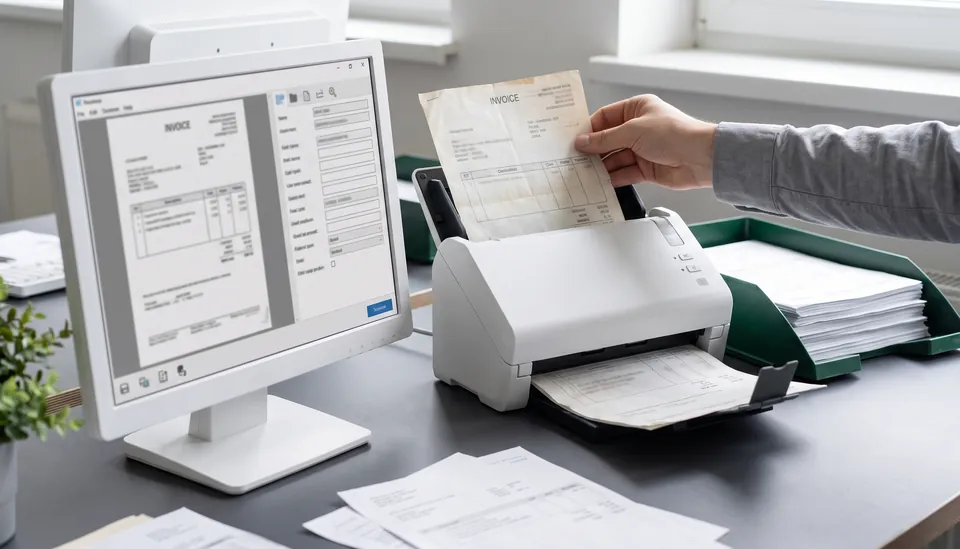
Map the document journey before automating it
We follow a document from arrival to its final business action: email or upload, classification, data capture, validation, approval and entry into a system of record. The assessment identifies repeated work, exception types and the consequences of a wrong field. Sample material should represent the real mix of layouts, scans, languages and poor-quality inputs, with appropriate permission to use it.
Extract information with context and traceability
The pipeline may combine OCR, layout analysis, structured extraction and deterministic rules. We define a schema for the fields your process needs and preserve a link to the source page or passage for review. Missing information stays missing rather than being filled with a plausible guess. Greek and English content, tables, dates, amounts and business identifiers are tested against the actual document population.
Build validation and an exception queue
Extracting an amount is different from authorising a payment. The design checks required fields, arithmetic, duplicates and consistency with approved reference records where available. Uncertain or conflicting results are routed to a reviewer with enough context to make a decision. Review thresholds are calibrated on representative data; a model’s own confidence statement is not treated as proof of accuracy.
Connect to operational systems safely
Approved outputs can feed ERP, CRM, document management or a case workflow through controlled integrations. We define permissions, retry behaviour, duplicate prevention and an audit trail for changes. Sensitive actions such as creating a supplier, changing bank details or approving payment remain subject to the organisation’s verification and authorisation process. The system records both the extracted suggestion and the accepted value where needed for accountability.
Measure value after human review
A successful pilot is evaluated on field-level accuracy, exception rates, total processing time and review effort, not just the speed of the AI step. We compare the existing process with the proposed workflow, including handling of failures and corrections. The operating plan covers document retention, provider settings, access, monitoring and re-evaluation when layouts or business rules change.

Invoice, order and business-document intake
A document-processing project can begin with a defined stream such as supplier invoices, purchase orders or service requests. We identify the required fields, supporting pages and destination system. The design distinguishes extracting a value from deciding what that value means for a payment or obligation. Business rules and responsible reviewers determine whether the extracted record can move forward.
Review exceptions with the source in view
The reviewer should be able to compare an extracted field with its location in the original document. We define queues for missing pages, conflicting totals, unknown suppliers and ambiguous values, with an appropriate owner for each exception. Corrections need a record that can support quality analysis. This makes human review a designed part of the workflow instead of a hidden manual repair step.
Assess performance using your document mix
A pilot should include the scans, layouts, languages and quality problems found in actual incoming material. We evaluate field-level correctness and the amount of review required before a record is usable. Processing time is considered alongside duplicate handling and integration success. A change in document format should trigger a visible review rather than silently degrade the downstream data.
What you receive
- Document journey and field schema
- Representative sample and evaluation results
- Extraction pipeline with source traceability
- Validation rules and human exception workflow
- Integration, operating controls and performance baseline
- Document and field specification with exception ownership
- Pilot results covering usable records, review effort and integration outcomes
Common questions
Can AI approve invoices or interpret contracts on its own?
The workflow can extract and organise information, but payment approval and legal interpretation remain with authorised people and established controls. Automation boundaries are agreed for each use case.
Will it work with scanned Greek documents?
We test a representative sample, including scan quality, fonts, tables and language. The result determines the supported scope and the amount of human review required.
What if an input format changes?
Monitoring and exception handling should reveal changes. We update the extraction or rules, then rerun the evaluation set before releasing the change.
Can the workflow handle invoices with several pages or attachments?
We can assess that requirement with representative document bundles. The design must establish which pages belong together, which fields are authoritative and how missing or conflicting material reaches review.
Can extracted information be checked against an ERP record?
Where suitable access is available, validation can compare agreed fields with the authoritative system. Differences and unavailable records should create an exception rather than an unverified automatic update.
Plan the next step
Explore AI servicesPlan an evidence-based AI pilotLegal teams & insurersSmall & medium businessesRelated established services
AI for Business AutomationConnected expertise
All services
Enterprise knowledge AI
Permission-aware knowledge assistants for policies, technical documentation and internal knowledge, with source references and measurable evaluation.
Explore service
AI agents & automation
Connect company knowledge and business systems with AI assistants and workflows designed around real operational needs.
Explore service
Data engineering & analytics
Data pipelines, databases, business intelligence, forecasting, and preparation of data for AI.
Explore service